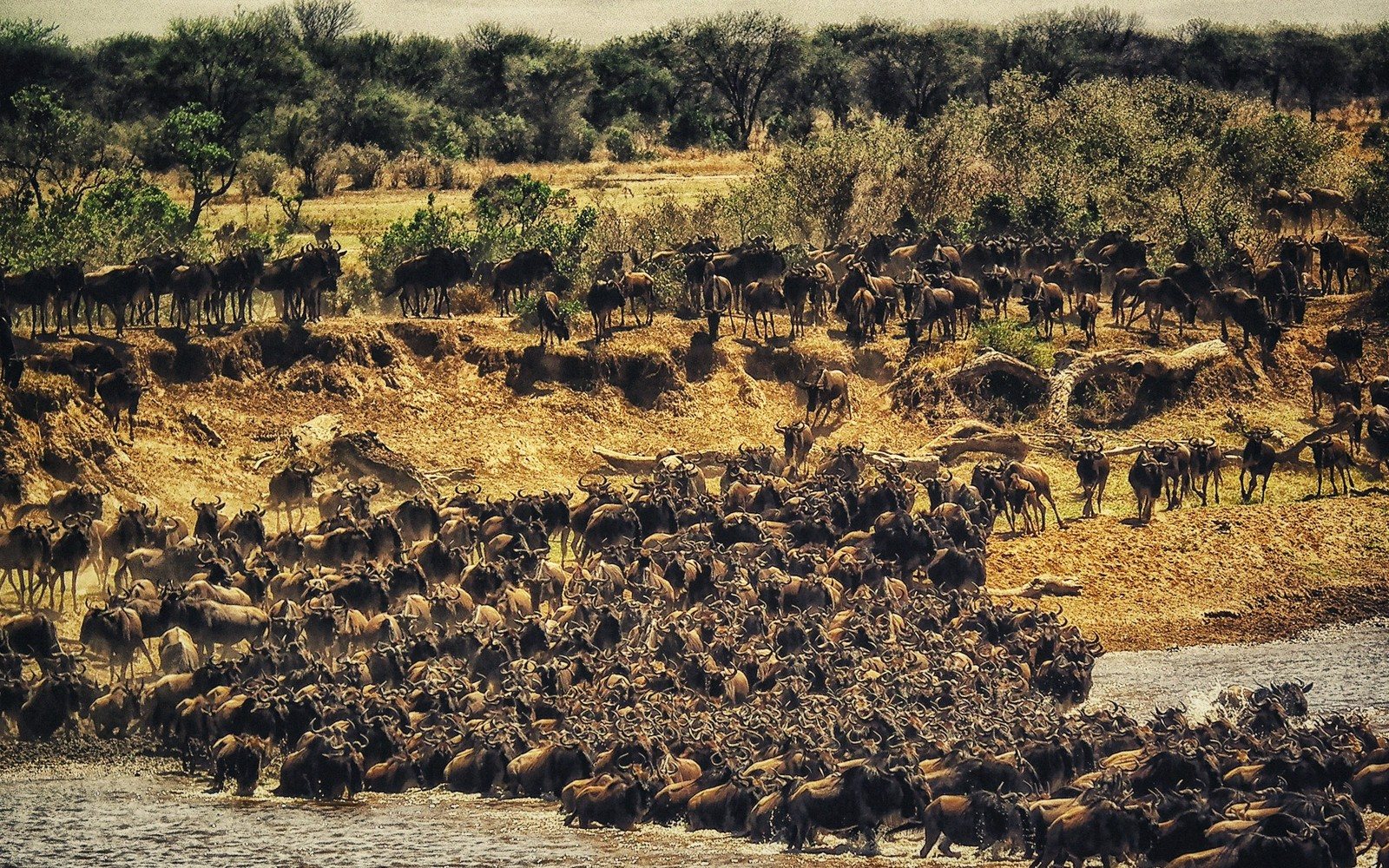
Call it a migration if you like, but the animals do not think of it that way. For the 1.5 million wildebeest and several hundred thousand zebra and gazelle that describe an annual circuit across the Serengeti-Mara ecosystem, this is simply life following rain. The grass grows, they move. The grass dries, they move again. The loop has been turning, more or less unbroken, for hundreds of thousands of years.
The circuit itself is roughly clockwise and covers some 1,800 kilometres in total. By December and January, most of the herds are massed on the short-grass plains of Tanzania's southern Serengeti and the Ndutu area — lured there by green shoots triggered by the short rains. This is calving season: something close to half a million wildebeest calves are born within a few weeks of each other in February and March, a survival strategy written in numbers. Predators eat their fill, but they cannot eat everything at once.
“It is less a migration than a slow, permanent weather system made of animals.”
As the southern plains dry out, the herds move northwest and then north, reaching the Serengeti's Western Corridor around June. The Grumeti River crossing here is less photographed than its famous cousin but no less violent — a gauntlet of Nile crocodiles that have been waiting months for precisely this. By July the leading columns are pressing toward the Mara River, and into Kenya.
Where Kenya comes in
The Maasai Mara — Kenya's northern extension of the same ecosystem — receives the herds roughly between July and October, though the timing shifts year to year with rainfall. The Mara River crossings are the spectacle that fills the world's camera rolls: wildebeest stacking up on the bank in their thousands, then lunging into water that holds crocodiles of remarkable size, then scrambling up the far bank in a chaos of mud and hooves. Crossings happen multiple times a day during peak season, and the animals often turn back and start again. The urgency is real; so, apparently, is the confusion.
What the Mara offers beyond the crossing is the open, game-rich grassland of the conservancies that ring the national reserve — Ol Kinyei, Naboisho, Olare Motorogi and others — where lower visitor densities and resident Maasai community ownership make for a different quality of encounter. The Maasai Mara and the other great parks each reward a different kind of patience; the Mara's particular gift is sheer abundance.
By November, the short rains arrive in the south. The herds follow them back down through the Serengeti, and the cycle resets. There is no beginning and no end — only the moment you happen to be standing in.
How to read the timing
No migration calendar is a guarantee. The animals track actual rainfall, not the tourist season, and a late short rains or an early long rains can shift key events by several weeks. As a general guide: calving peaks in February; the Grumeti crossings build through June; the Mara crossings are most intense in August and September; and the return south begins in October and November.
The practical upshot for travellers is that flexibility counts for more than a fixed date. A week in the Mara in late July might find the river barely trickling with animals; a week in early August might deliver six crossings before lunch. Staying longer, camping closer, and talking to guides who are watching the horizon rather than the itinerary — these matter more than any chart.
What the migration asks of you, ultimately, is the same thing it asks of the wildebeest: read the land, follow the conditions, stay attentive. The grass is always the point. Everything else — the crocodiles, the lion ambushes, the columns of dust stretching to the horizon — is what happens when a million animals take the grass seriously.
Maasai Mara
Kenya's national reserve forming the northern section of the Serengeti-Mara ecosystem
Serengeti
Tanzania's vast plains ecosystem sharing the migration circuit
Grumeti River
Western Corridor crossing point in Tanzania, June
Mara River
primary Kenya crossing point, peak July–October