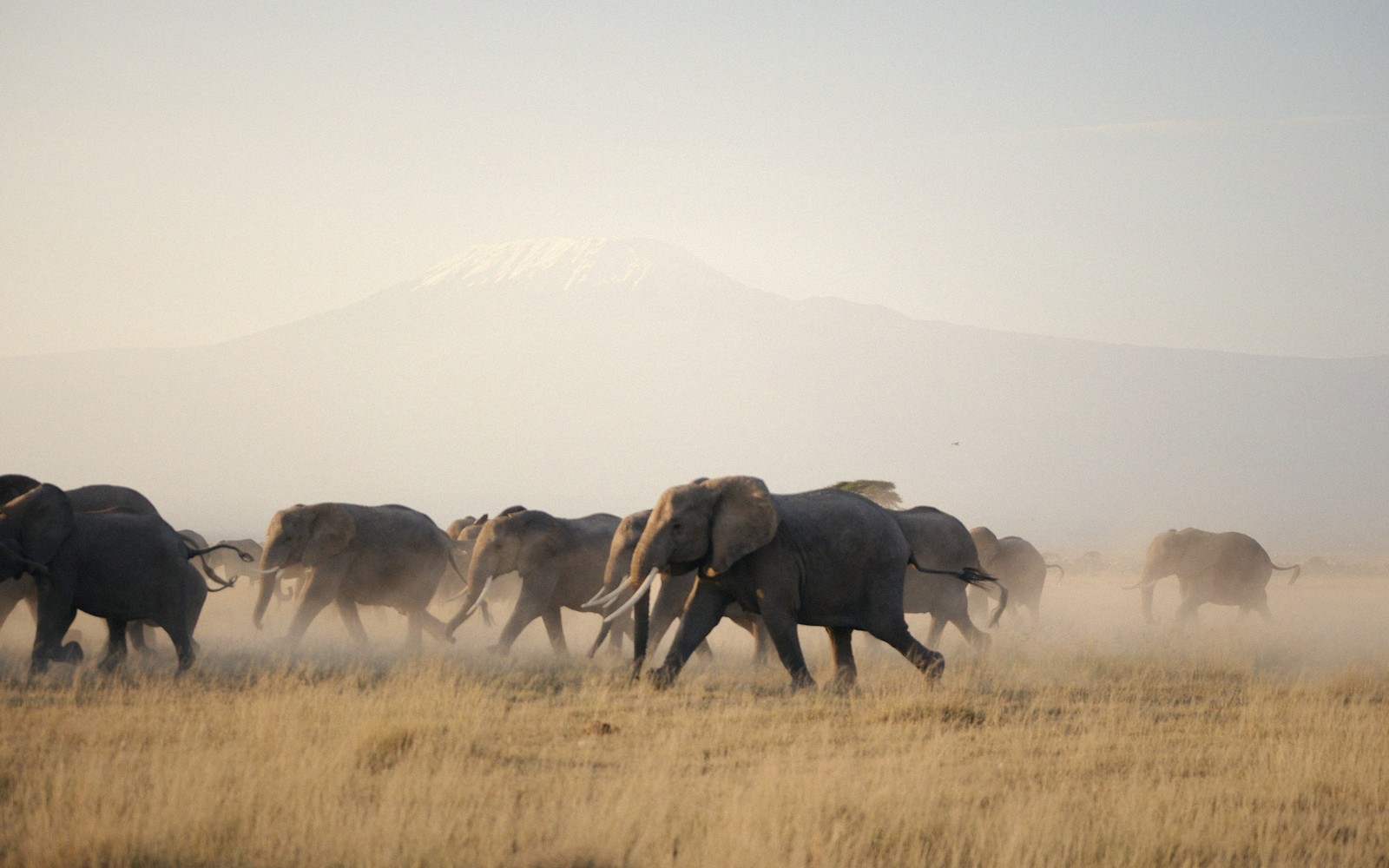
Coined by hunters for the five hardest animals to kill, the term has outlived its origins — today it's a spotter's shorthand for the wildlife encounters that define a Kenya safari.
The Animals Themselves
The Big Five aren't the five largest animals in Africa, nor the five most dangerous in any objective sense. The list — lion, leopard, elephant, Cape buffalo, and rhinoceros — dates to the era of trophy hunting, when these particular animals were considered the most hazardous to pursue on foot. The phrase has aged awkwardly in places, but on the ground in Kenya it remains a useful frame: these are the animals most visitors most want to see, and the ecosystems that support them are among the most extraordinary on earth.
Each has its own temperament. Lions are social and frequently visible, draped across termite mounds or sprawled in the shade of a fig tree, ignoring vehicles with magnificent indifference. Leopards are the opposite — solitary, secretive, more often glimpsed as a tail disappearing into riverine scrub than watched at length. Elephants move in matriarchal family groups that can number in the dozens, and they have moods; the bulls that wander alone are the ones to read carefully. Cape buffalo are frequently underestimated — big-shouldered, heavy-horned, prone to turning and watching you with an expression that drivers have learned to respect. Rhinoceros, both black and white, are the rarest, the most embattled, and — for most visitors — the most affecting to encounter.
Where to Find Them
Kenya's great parks each have their own personality, and the Big Five are not evenly distributed.
The Maasai Mara is Kenya's most celebrated wildlife reserve, and for lion in particular it is near-unbeatable. The open savannah gives predators almost nowhere to hide, and the reserve's famous prides are large and well habituated to vehicles. Leopard sightings happen most often along the luggas — seasonal stream beds — and around the fig trees that edge the Mara River. Elephant are present year-round; buffalo herds here can be enormous, sometimes many hundreds strong. Black rhino survive in the Mara ecosystem but in small numbers; sightings are possible, not guaranteed.
Amboseli, at the foot of Kilimanjaro, is the elephant reserve par excellence. The herds here are among the best-studied in Africa, and the combination of big tuskers moving against the snowcapped mountain has become one of Kenya's defining images. Lion and buffalo are reliably present; leopard less so in the open terrain. Rhino are absent from Amboseli itself — a consequence of past poaching — though conservation efforts in the wider ecosystem continue.
Tsavo, divided east and west, covers an enormous sweep of semi-arid country and holds all five species, with the added character of its "red elephants" — animals stained rust-red by the distinctive volcanic soil when they dust-bathe. Tsavo West is where you are most likely to see rhino; Ngulia Rhino Sanctuary, within the park, offers a protected population of black rhino. The landscape is dramatic and the density of vehicles is lower than the Mara, which suits travellers who prefer their wildlife without a convoy.
Ol Pejeta Conservancy in Laikipia is arguably the single best destination in Kenya for rhino. It holds the largest black rhino population in East Africa and is the permanent home of the last two northern white rhinos on earth — a sobering footnote to the century's conservation history. Ol Pejeta also carries healthy populations of lion, leopard, elephant, and buffalo, making it a credible Big Five destination that feels more intimate than the major national parks.
Solio Ranch, also in Laikipia, has an exceptional rhino density and has supplied breeding animals to reserves across East Africa — a quiet success story in a region that has needed them.
A Word on Rhino
The black rhino's story in Kenya is one of near-catastrophe and slow recovery. Numbers collapsed through the 1970s and 1980s due to poaching; the Kenya Wildlife Service and a network of private and community conservancies have brought the population back from the brink, though it remains critically endangered. Seeing one — a broad, prehistoric silhouette moving through thornbush at dusk — is a privilege that carries genuine weight. It's worth knowing that the conservation fee in your park entry goes, in part, toward the work that made it possible.
People & places in this pieceMaasai Mara
Kenya's most celebrated wildlife reserve, southwest, open savannah
Amboseli
national park at the foot of Kilimanjaro, famed for elephant herds
Tsavo
Kenya's largest national park complex, divided east and west
Ol Pejeta Conservancy
Laikipia conservancy; largest black rhino population in East Africa