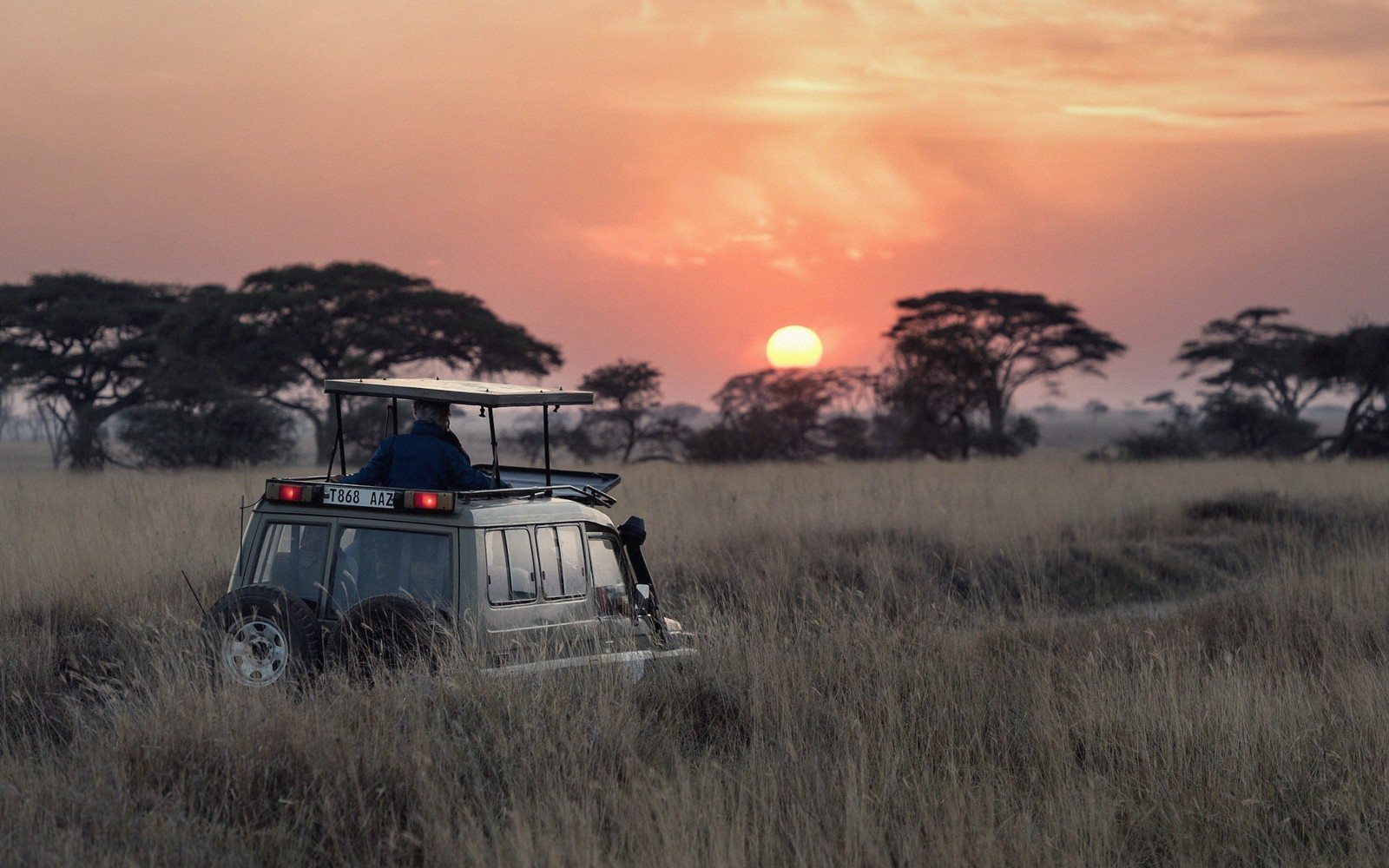
Kenya's wildlife areas are not interchangeable. Each of the four great parks has its own character — its own light, its own cast of animals, its own reason to go.
Maasai Mara is the one most travellers picture first, and it earns the attention. The Mara's short-grass plains roll into Tanzania's Serengeti without ceremony, which is exactly why the wildebeest don't notice the border. From July through October, the western corridor fills with the crossing herds — crocodile-patrolled rivers, dust, noise, spectacle. But the Mara is worth visiting any month: its resident lion prides are among the densest in Africa, leopard haunt the riverine forest along the Talek and Mara rivers, and cheetah hunt in open daylight. Stay on the conservancies — Olare Motorogi, Naboisho, Ol Kinyei — and you trade the minibus congestion of peak season for exclusivity and night drives.
Amboseli is Kilimanjaro's park, and that is not a small thing. On a clear morning, the mountain fills the southern sky above herds of free-roaming elephant — some of the most studied and least disturbed in Africa, monitored for decades by field researchers. The swamps fed by snowmelt keep the park green even in the dry season and attract enormous concentrations of elephant, buffalo and pelican. The land here is Maasai, and community relationships shape how the park functions. Come for the views and the elephants; stay for the quality of the light at dawn.
Tsavo is vast in a way that recalibrates the sense of scale. East and West together cover an area larger than Wales. Tsavo East is open, red-soiled and semi-arid — the landscape of the man-eating lions of Tsavo, made famous in 1898 during the construction of the Uganda Railway. The red elephants here — coated in the laterite dust — are unmistakable. Tsavo West is greener, more dramatic: the Mzima Springs push millions of litres of crystal water to the surface daily, fed by rainfall filtering through the volcanic Chyulu Hills, and you can watch hippo and barbel from an underwater viewing chamber.
Samburu, north of the equator, is where Kenya's wildlife quietly diverges from the standard savannah roster. The Ewaso Ng'iro river anchors the reserve and draws reticulated giraffe, Grevy's zebra, beisa oryx and the gerenuk — that long-necked antelope that browses standing upright on its hind legs. These are the so-called Northern Specials, found here and rarely elsewhere in the country. Samburu also delivers excellent leopard sightings and an atmosphere that feels genuinely frontier: drier, quieter, further from everything.
Four parks, four itineraries. Each one asks something different of the eye.
People & places in this pieceMaasai Mara
savannah reserve in southwest Kenya, adjoining the Serengeti
Amboseli
park in southern Kenya, set below Mount Kilimanjaro
Tsavo
Kenya's largest protected area, split into East and West
Samburu
semi-arid reserve in northern Kenya on the Ewaso Ng'iro river