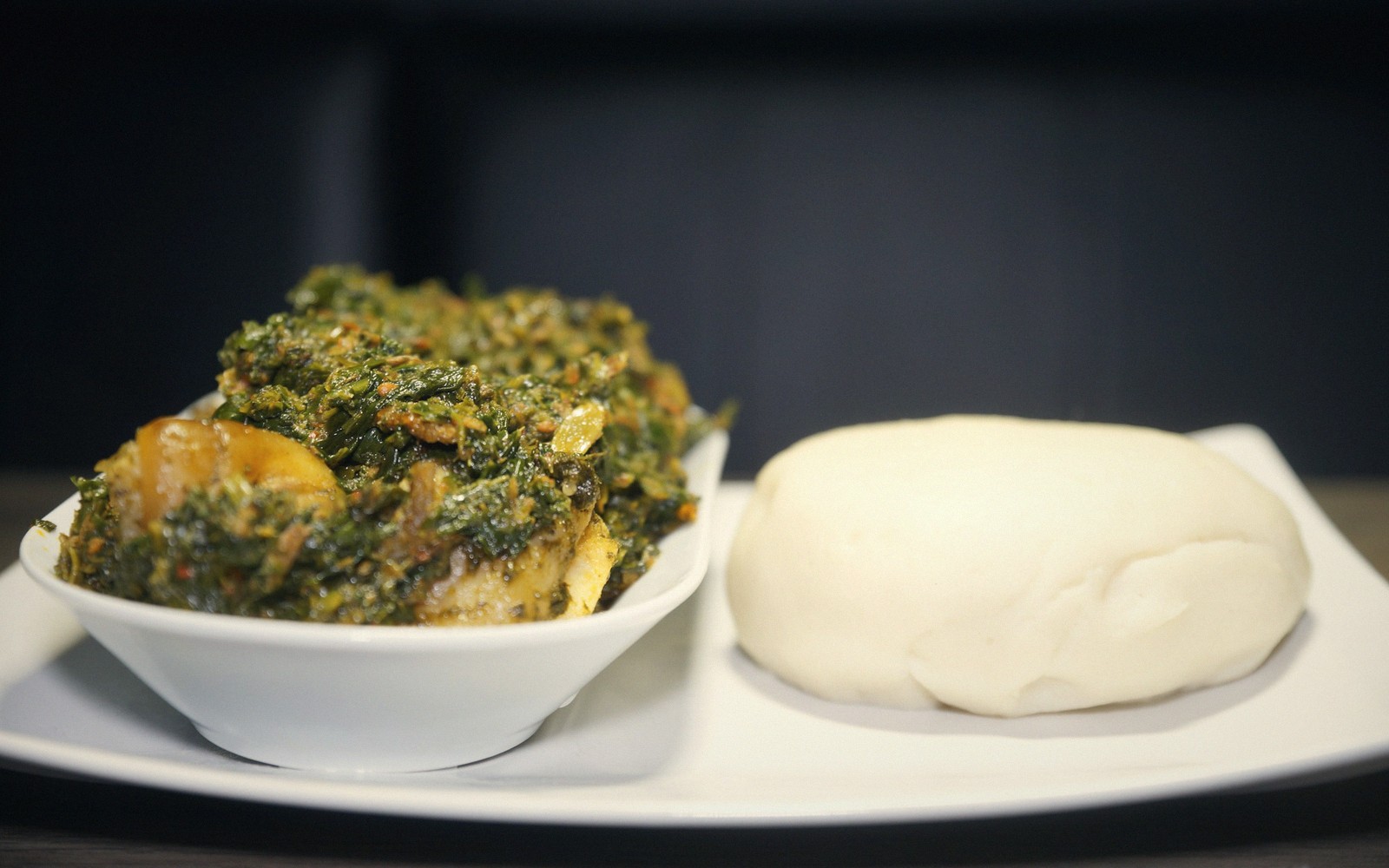
Grilled meat is just the beginning — the real Kenyan table is fermented, coastal, starchy and surprising.
The Staples That Actually Feed the Country
Nyama choma — charcoal-grilled goat or beef, shared with bare hands and a cold Tusker — is Kenya's most photogenic food, but it is not the meal most Kenyans eat most often. That role belongs to ugali, a stiff maize porridge cooked until it pulls clean from the pot. Every region makes it; every household has an opinion on the correct firmness. You eat it by pinching off a piece, rolling it into a small cup between your fingers, and using it to scoop whatever sits alongside: braised sukuma wiki (collard greens cooked down with onion and tomato), a spoonful of maharagwe (red kidney beans simmered with coconut milk in Coast kitchens), or a piece of tilapia pulled fresh from Lake Victoria. Ugali is not photogenic. It is foundational.
“If ugali is the anchor, sukuma wiki is the sail — greens whose name means, literally, ‘push the week.’”
Its highland cousin is githeri, a slow-boil of maize and beans that Kikuyu farmers have been eating for centuries and that school canteens across the country have made universal. Add potato, pumpkin or a bone-in piece of goat and it becomes irio in some households, a mash of layered starch and green. Meru and Embu cooks make versions studded with nduma (arrow-root) or ngwaci (sweet potato) — smallholder crops that have fed the mountain slopes long before anyone wrote them into a development report.
Fermented, Coastal and Street-Smart
Fermentation runs quietly through Kenyan food. Mursik, the Kalenjin sour milk fermented in a gourd sealed with charcoal and cattle fat, carries a smoky, tangy intensity that startles newcomers and becomes addictive fast. It is the drink that athletes in the Rift Valley training camps grow up on, though its roots are pastoral and old. The Maasai make a related version, kule naoto, similarly fermented and similarly important — food, ceremony and identity at once. Further inland, togwa (a lightly fermented porridge made from millet or sorghum) is both a weaning food and a refreshing drink in parts of western Kenya.
The coast operates under entirely different flavours. Arab, Portuguese, Indian and Swahili trade winds have been seasoning Mombasa's food for over a millennium, and the result is a cuisine of cardamom, tamarind, coconut cream and slow-cooked richness. Biryani here is not a restaurant affectation — it is cooked for funerals, weddings and Friday lunches, layered with spiced meat and fried onion. Pilau is its more everyday sibling, the rice toasted in ghee with whole spices before any water touches it. Mahamri — a slightly sweet, cardamom-spiced deep-fried dough — arrives at breakfast with a cup of chai so thick with milk it is almost a meal in itself. Eat it at a plastic-table canteen in the back lanes of the Old Town and you are eating something continuous with a thousand years of Swahili trade.
Street food in Nairobi and every market town runs on mandazi (the plainer, less sweet cousin of mahamri), mutura (a Kikuyu blood-and-offal sausage grilled over charcoal), and smokie pasua — a Vienna sausage split and filled with kachumbari, that bright relish of raw tomato, red onion, chilli and coriander that improves almost everything it touches. Roast maize (mahindi choma) from a charcoal brazier, rubbed with lemon and chilli, costs almost nothing and tastes of every Kenyan town at dusk.
The Drinks, the Greens and What You Might Miss
Chai is the national drink with almost no competition. It is made by simmering milk, tea leaves, water and sugar together — not brewed separately — and the result is richer and more orange than anything a teabag ever produced. Upcountry, a thermos of chai on the table is hospitality's simplest gesture.
Muratina is a fermented brew made with the fruit of the muratina (sausage) tree, used ceremonially by Kikuyu communities and rarely found commercially — if someone offers it to you, accept with both hands. Tusker lager remains the everyday beer; chang'aa, a distilled grain spirit, is potent, unregulated in its home-distilled form, and famous in cautionary tales.
The greens deserve a final word. Managu (African nightshade), mrenda (jute mallow, mucilaginous and mineral-rich) and terere (amaranth) turn up in western and Nyanza kitchens alongside sukuma wiki. They are cooked briefly, seasoned simply, eaten with ugali, and they are better than most diners who encounter them expect. Indigenous vegetables fell out of fashion in the mid-twentieth century under pressure from promoted hybrids, but they are returning to menus and markets — not as a trend but as a recognition of what was always there.
Kenya's real table is plural and quietly spectacular. You will not discover all of it in one trip, but you will eat very well trying.
People & places in this pieceTusker
Kenya's flagship lager, brewed by Kenya Breweries since 1922
Lake Victoria
East Africa's great lake; source of much of Kenya's tilapia
Old Town, Mombasa
historic Swahili quarter where coastal food culture is most concentrated