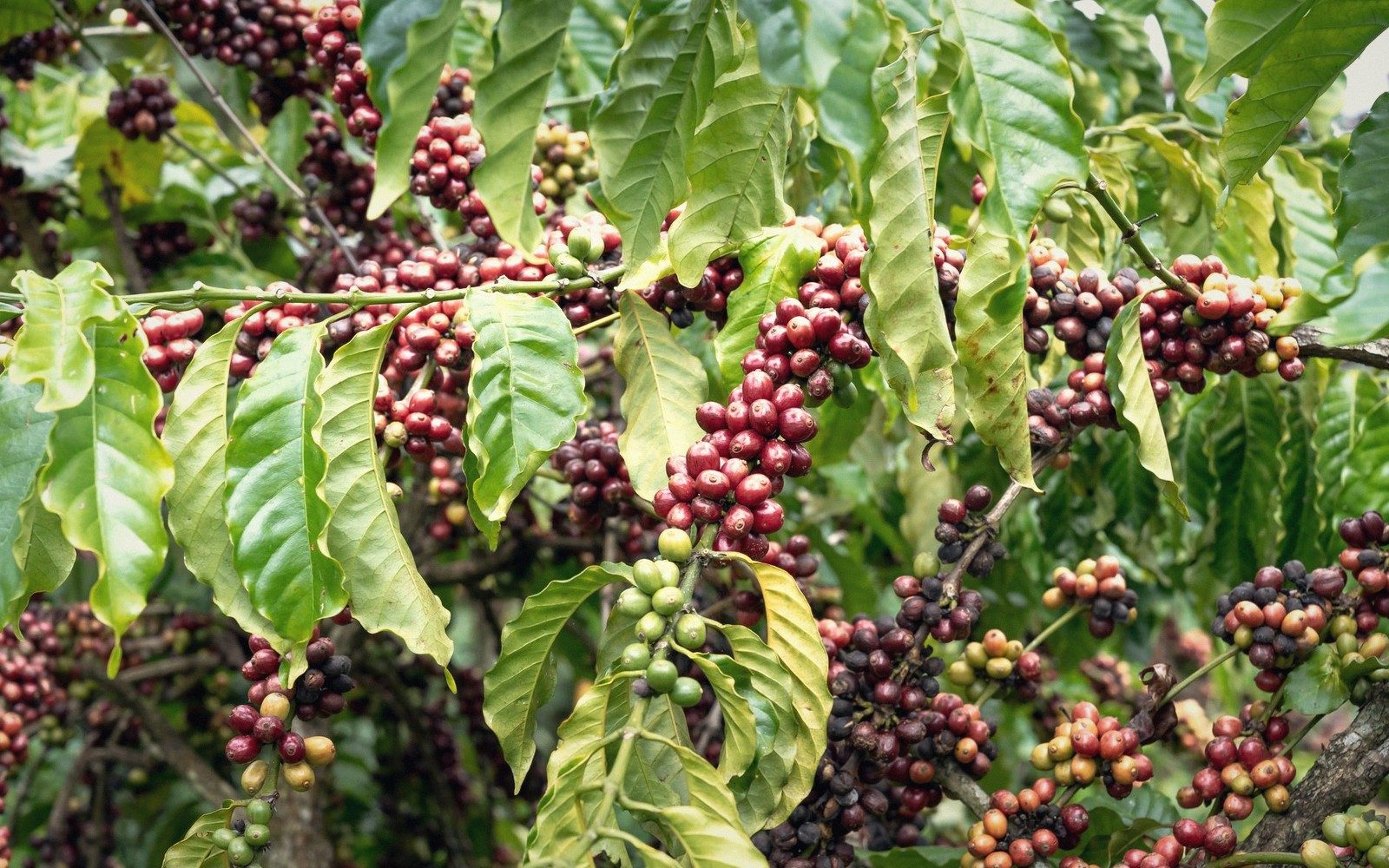
A Long-Rooted Tradition
Kenya's coffee story is short by historical standards — the crop arrived from Ethiopia in the late nineteenth century, introduced via mission stations and colonial settlers — but its impact on the world's coffee palate has been disproportionate. The country's highland belt, running through the slopes of the Aberdares and the foothills of Mount Kenya, sits at elevations between roughly 1,400 and 2,000 metres, where volcanic soils, equatorial light and cool nights conspire to produce a berry of uncommon density and brightness. The result is a cup that specialty roasters around the world covet: full-bodied, wine-like, with a sharp, clean acidity that most other origins struggle to replicate.
At the centre of Kenya's reputation are two varietals developed in the 1930s under the Scott Agricultural Laboratories in Kabete: SL-28 and SL-34. Both were selected for drought tolerance and flavour, and by the time the Second World War ended, they had already begun attracting serious attention among buyers in Europe. SL-28 in particular — thriving in drier conditions, producing a large, bluish-green bean — became a benchmark for what arabica coffee could taste like. The combination of resilience and cup quality made it, and its sibling SL-34, the backbone of Kenya's export reputation for decades.
The Problem with Perfection
The SL-28's greatest weakness turned out to be biological. Coffee Berry Disease (CBD), caused by the fungal pathogen Colletotrichum kahawae, is endemic to East Africa's highland growing zones, and it is devastating when conditions favour it — in some bad seasons, losses have reached close to sixty percent of a crop. The SLs, for all their flavour, proved highly susceptible, and by the latter half of the twentieth century CBD was a chronic drag on Kenyan yields, farmer incomes and the overall quality of what reached export.
“Plant the beautiful but vulnerable SLs and risk catastrophic losses, or plant the sturdy but unremarkable Ruiru 11.”
The response from researchers was Ruiru 11, introduced in 1985 by what was then the Coffee Research Station (now the Coffee Research Institute, a state institution based at Ruiru, just north of Nairobi). Ruiru 11 was a genuinely impressive feat of plant breeding: resistant to CBD and to coffee leaf rust, capable of high yields, and compact enough to grow at closer planting densities. On paper, it solved the major problems. In the cup, it disappointed. The flavour profile was flat compared to the SLs — serviceable for commercial blends, but a long way from the wine-bright character that had made Kenyan coffee famous. Specialty buyers largely turned their backs on it.
The obvious answer was to cross the two: blend Ruiru 11's disease resistance with the SLs' flavour genetics. It was tried, and the results improved — cup quality rose meaningfully over pure Ruiru 11 — but the hybrids never closed the gap with the best SL-28 lots. Farmers and cooperatives were caught in a practical bind: plant the beautiful but vulnerable SLs and risk catastrophic losses, or plant the sturdy but unremarkable Ruiru 11 and accept a lower price at auction.
Enter Batian
In 2010, the Coffee Research Institute released Batian — named for one of the twin peaks of Mount Kenya, the highest point on the massif. It was the product of years of careful line selection and crossing within the Institute's breeding programme, and its genetic profile sits significantly closer to SL-28 than to Ruiru 11. That lineage matters enormously: Batian was never positioned as a yield machine in the Ruiru 11 mould, but as a genuine quality cultivar with built-in disease resistance.
| SL-28 / SL-34 | Ruiru 11 | Batian | |
|---|---|---|---|
| In the cup | The benchmark — wine-bright, famous | Flat; commercial-blend grade | Close to SL-28; beat average lots in trials |
| Disease | Highly susceptible to CBD | Resistant to CBD and leaf rust | Strongly resistant to both |
| Yield | Moderate | High, dense planting | High per plant |
The early cupping results were striking. In comparative trials, Batian scored above a number of SL-28 samples — though researchers noted that many of those benchmarks were regular-grade SL-28 lots rather than the finest micro-lot expressions of the varietal. That caveat opened an interesting methodological debate within Kenya's coffee community: Batian may be routinely better than average SL-28, but whether it matches the very best SL-28 from a top site in a perfect season remains genuinely contested, and honestly, that is a high bar to set for any varietal.
What is harder to dispute is Batian's resistance profile. In trials it showed strong resistance to both CBD and coffee leaf rust, the two pathogens that have historically done the most damage on Kenyan farms. Yield per plant is high, which matters greatly to the smallholder farmers — many of them growing just a few hundred trees on land measured in fractions of a hectare — who form the backbone of Kenya's coffee-growing communities. A healthy plant that produces well and sells at a premium price is the difference between a good year and a grinding one.
The practical bottleneck has been seed supply. Batian is an open-pollinated variety rather than a hybrid, which means farmers can in principle save and replant seed — but the Coffee Research Institute has found the distribution of certified Batian seed difficult to scale at the pace the industry needs. Demand from farmers eager to replant ageing SL-28 and Ruiru 11 blocks has consistently outrun the Institute's ability to supply. That is, in a sense, the best problem to have: a varietal so widely wanted that the seed keeps running out. Solving it is now among the Institute's stated priorities.
Whether Batian ultimately inherits the full mantle of SL-28 — the varietal that put Kenya's highlands on the world coffee map — is still an open question. But its combination of flavour, resistance and yield makes it the most promising Kenyan cultivar to emerge in a generation, and the farmers replanting their fields with it are, by most accounts, optimistic.
The timeline- 1930sSL-28 and SL-34 selected at Scott Agricultural Laboratories, Kabete
- 1985Ruiru 11 released by Coffee Research Station, Ruiru
- 2010Batian variety released by Coffee Research Institute
Coffee Research Institute
state research body based at Ruiru, north of Nairobi; develops and releases coffee varietals
Scott Agricultural Laboratories, Kabete
colonial-era research station where SL varietals were selected
Ruiru
town north of Nairobi; home of the Coffee Research Institute
Batian
highest peak of Mount Kenya massif; namesake of the 2010 varietal