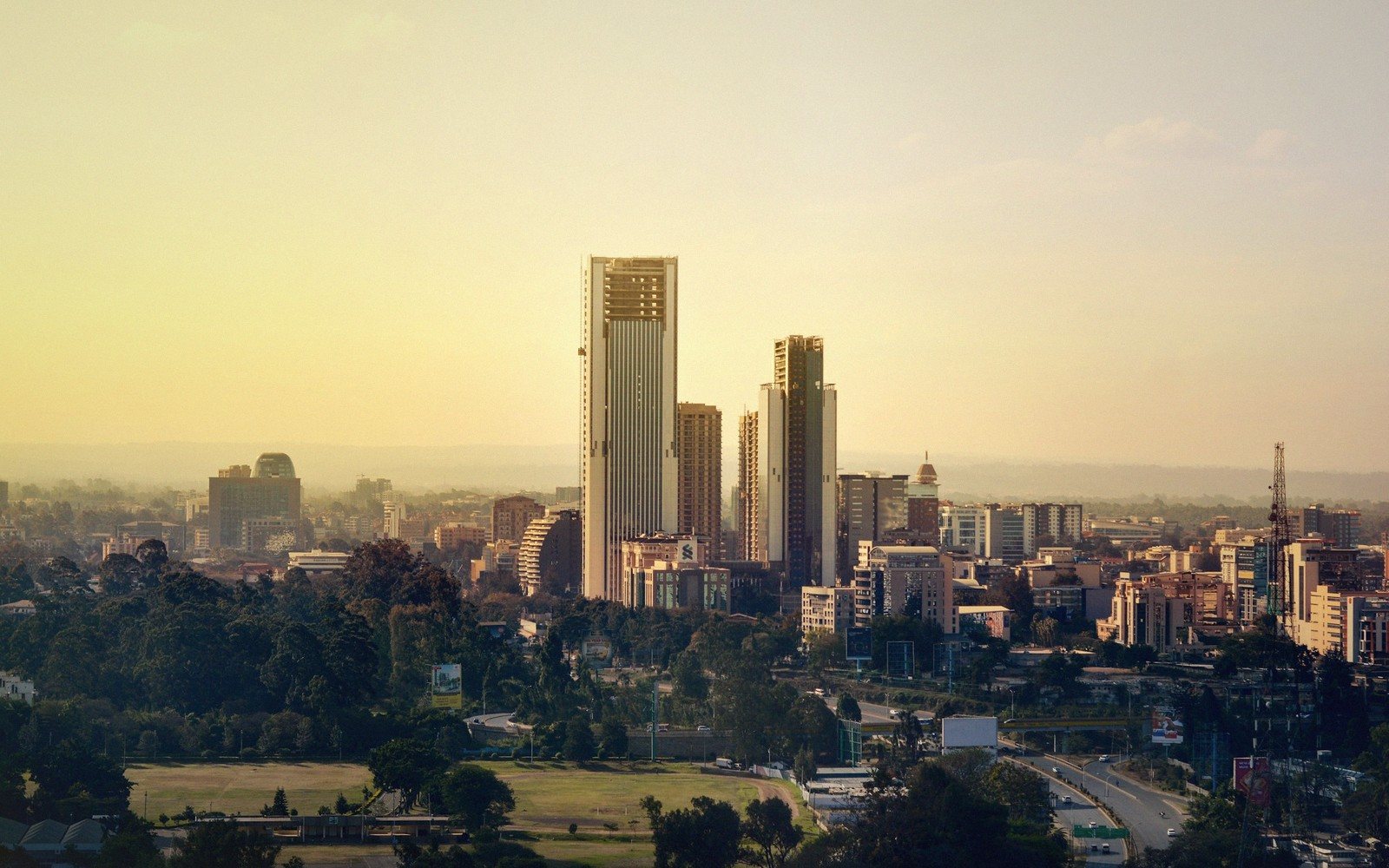
The City Itself
Nairobi is the youngest of Africa's great capitals and one of its most restless. Founded in 1899 as a railway depot on the Uganda Railway, it graduated from a muddy supply town to a colonial administrative centre to an independent nation's capital in the space of six decades. Today it holds somewhere north of four million people depending on how you draw the boundaries, and its skyline — glass towers, elevated highways, perpetual cranes — announces a city that has not yet decided where it stops.
The centre rewards walking if you pick your timing. The National Museum of Kenya on Museum Hill is one of East Africa's strongest, with collections spanning palaeontology, natural history and Kenyan cultural heritage. The Joy Adamson Gallery there displays original paintings she made of Kenya's peoples — meticulous, pre-fame, quietly remarkable. Across town, the Railway Museum near the old station holds the actual Field Car used to hunt the Tsavo man-eating lions in 1898, plus enough narrow-gauge nostalgia to keep a railway enthusiast occupied for hours. The Karen Blixen Museum in the leafy suburb of Karen occupies the farmhouse she wrote about in Out of Africa, set against the Ngong Hills; the hills themselves are an easy half-day walk, with views back across the entire Nairobi basin.
The city's markets shift registers quickly. Maasai Market, which rotates between venues on different days of the week, draws vendors from across the country with beadwork, soapstone carvings and kanga cloth. Gikomba, east of the centre, is one of East Africa's largest second-hand clothing markets — chaotic, fascinating and extremely cheap. City Market in the centre is good for fresh produce and less hectic than its reputation suggests. Food, meanwhile, has diversified far beyond the old hotel dining rooms: Nairobi now has a serious restaurant scene, with Swahili coastal cooking, nyama choma yards, Indian-Kenyan fusion, and Ethiopian restaurants clustered particularly in the Westlands neighbourhood all competing for attention.
Silicon Savannah
Nairobi's other identity is technological. The Nairobi tech and startup ecosystem — branded, inevitably, the Silicon Savannah — has grown since the early 2010s into one of the continent's most substantial. The neighbourhood of Westlands and the wider complex around iHub, the innovation hub founded in 2010, helped catalyse a generation of Kenyan entrepreneurs. Kenya's early lead in mobile money, anchored by M-Pesa (launched by Safaricom in 2007), gave local developers a live, large-scale digital payments infrastructure that most of the world still lacks; startups here could build on real rails rather than hypothetical ones.
The ecosystem has since matured from scrappy co-working spaces into a network of accelerators, venture funds and multinational R&D offices. Several global tech companies have established African headquarters in Nairobi rather than Johannesburg or Lagos. The city's relative political stability, English-medium education system, large university sector — Nairobi, Kenyatta, Strathmore, USIU and others — and its position as the regional hub for East and Central Africa all feed the concentration. For a visitor, Silicon Savannah is less visible than, say, a game park, but the evidence is everywhere: from the seamless M-Pesa transactions at a roadside mandazi stall to the startup pitches audible through café windows in Kilimani.
Nairobi National Park
No other capital city on earth has anything quite like it. Nairobi National Park begins less than seven kilometres from the central business district, and on a clear day you can photograph a black rhinoceros with Nairobi's skyline stacked behind it — an image that never really gets old. The park covers around 117 square kilometres of open grassland, riverine forest and rocky gorges, and supports lion, leopard, cheetah, giraffe, buffalo, zebra, wildebeest, over four hundred bird species, and one of Kenya's most important black rhino sanctuaries.
The park's southern boundary is unfenced, which means it connects to the wider Kitengela ecosystem and allows seasonal wildlife movement — though that corridor is under serious and ongoing pressure from urban sprawl. The wildebeest that calve on the short-grass plains south of the park each year depend on it. The park also contains the Animal Orphanage and the Nairobi Safari Walk, both useful for visitors who want close-up encounters with animals being rehabilitated. Entrance fees go toward Kenya Wildlife Service conservation work, and early morning drives — when the light is low and the animals are moving — are the way to do it.
Around Nairobi, within an hour or two by road, the options multiply: the Ngong Hills for hiking, Lake Magadi in the southern Rift for soda-lake drama and flamingos, Ol Donyo Sabuk National Park for walking and forested hills, and the agricultural smallholder country around Limuru and Tigoni, where tea estates stripe the escarpment above the Rift. The city, in other words, is not just a transit point — it is a region in its own right, dense and layered, and it takes more than one visit to read it properly.
- 1899Nairobi established as Uganda Railway depot
- 1963becomes capital of independent Kenya
- 2007M-Pesa mobile money launched
- 2010iHub founded, Silicon Savannah begins to take shape
Joy Adamson
conservationist and painter; gallery at National Museum holds her pre-fame portraits of Kenyan peoples
Karen Blixen Museum
farmhouse home of Out of Africa author, Karen suburb, backed by the Ngong Hills
National Museum of Kenya
Museum Hill institution covering palaeontology, natural history and cultural heritage
Railway Museum
near Nairobi station; holds Uganda Railway artefacts including the Tsavo lion field car